


The origin of the famous oil portrait of Johann Sebastian Bach: his admission to the Mizler Society.

In June 1747, Johann Sebastian Bach was officially accepted as the 14th member of the prestigious Societät der musikalischen Wissenschaften (Society of Musical Sciences), founded by his former student Lorenz Christoph Mizler.
To be admitted, the candidate needed to meet rigorous requirements: in addition to submitting a theoretical composition that proved their mastery, it was necessary to deliver an oil portrait that became the main visual reference we have of the composer.
The Mizler Society
The Mizler Society was not for amateurs; it was an elite circle that sought to reaffirm music as part of the Quadrivium —the four liberal mathematical arts of antiquity. It brought together intellectuals who saw music not merely as gallant entertainment, but as a true scientific discipline , deeply connected to mathematics. Among its members were giants such as Georg Philipp Telemann (member no. 6) and George Frideric Handel (member no. 11). For these men, musical harmony was a direct reflection of the divine order of the universe.
Mathematics in music was not understood as a cold exercise in calculation, but as the "science of proportions." It was believed that the laws governing musical intervals were the same as those governing the movement of the planets and the geometry of nature. The New Bach Reader (Doc. 238) recounts Bach's reception in society, highlighting that his admission was not only due to his fame, but to his unparalleled ability to transform these mathematical truths into living sonic structures, proving that music was the "science of sounds in relation to harmony and rhythm."
In 1738, the academic Johann Abraham Birnbaum defended Bach against critics who considered his style excessively complex. Drawing on ideas from theologians and philosophers of the time, Birnbaum argued that Bach's harmony—with its multiple voices that "work wonderfully within and around each other, without the slightest confusion"—was a mirror of divine perfection itself. Georg Venzky, another member of the Mizler Society, summarized this philosophy: "God is a harmonious being. All harmony originates from his wise order... For beauty and perfection, conformity consists in diversity." For the Society and for Bach, dense counterpoint was not a defect to be avoided, but the most sublime imitation of the laws of nature itself.
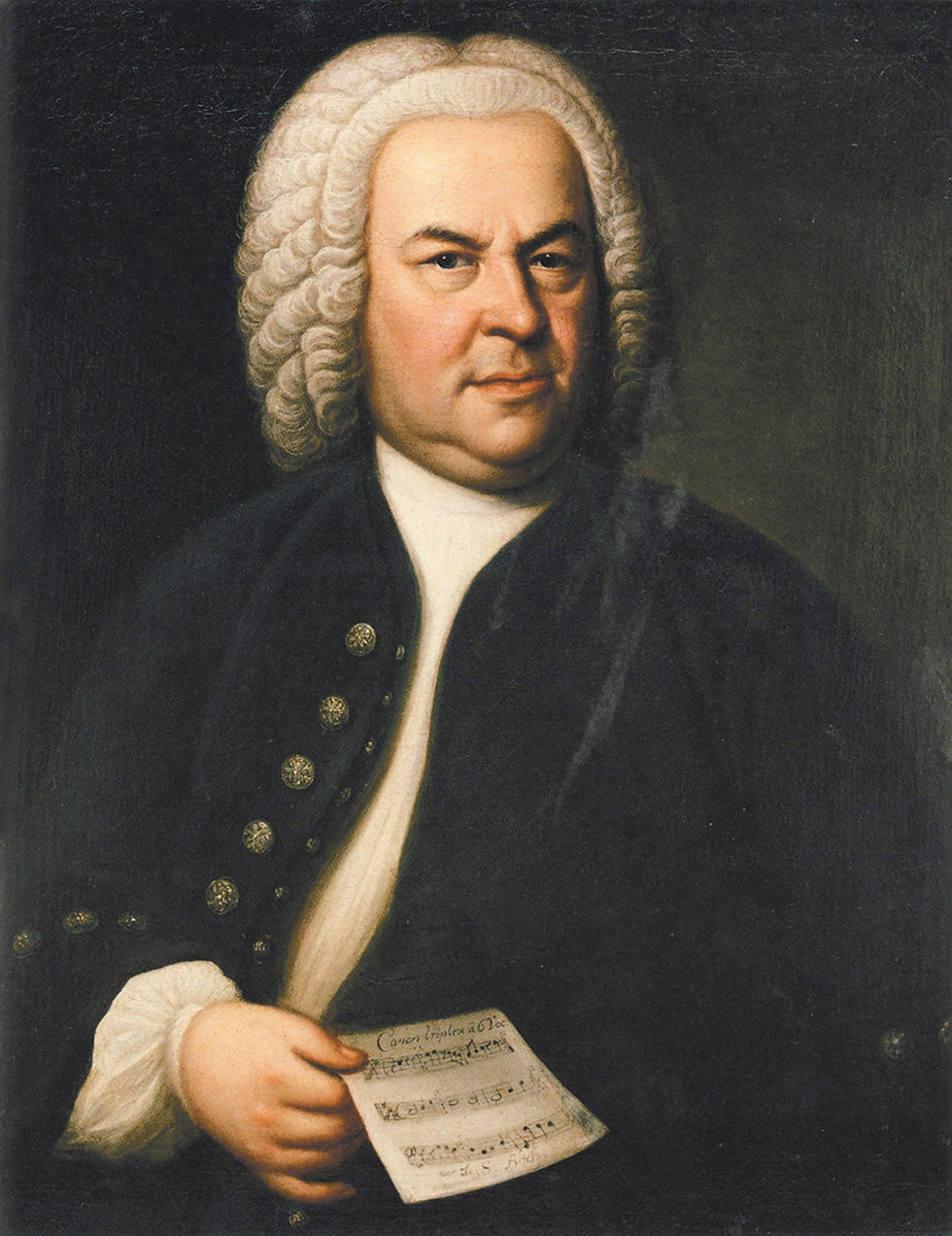
The famous Haussmann portrait: the official image of Johann Sebastian Bach.
The image that dominates our imagination today regarding Johann Sebastian Bach —the gentleman with the white wig, stern expression, and penetrating gaze—is not a casual snapshot. It is the portrait painted by Elias Gottlob Haussmann (1746), commissioned specifically for the admission process to the Mizler Society. It was a requirement of the institution that all members have their portraits preserved at its headquarters for study and archiving.
Haussmann was the official painter of the city of Leipzig ( Hofmaler ), known for portraying the mercantile and academic elite with realism and dignity. The fact that Bach posed for him (there are two versions, one from 1746 and a replica from 1748) demonstrates the institutional importance of the event. There are documents confirming that Bach paid for the painting and engraving of his canon as part of his admission obligations.
In the portrait, Bach is not holding an instrument, but rather the score of one of his most ingenious musical enigmas: the Triple Canon for 6 Voices (BWV 1076) . Christoph Wolff points out that this choice was not accidental. By displaying the canon in the painting, Bach presented his credentials to the academics of Leipzig, asserting himself as a true architect of polyphony , for whom musical creation was the supreme manifestation of order and proportion.

The Canonical Variations: Music as an Exact Science
In addition to the portrait, the Society required the presentation of a theoretical work or one of great technical complexity. Bach's contribution was the work Canonical Variations on "Vom Himmel hoch da komm ich her" (BWV 769) . This is a set of brilliant variations for organ based on a famous Lutheran Christmas hymn, elevating the technique of the canon to extreme limits.
In this composition, Bach fuses the devotional emotion of Martin Luther's melody with the mathematical precision demanded by Mizler, through the use of canons at different intervals and movements. A fascinating example is the Fifth Variation ( L'altra sorte del canone ), where Bach uses the canon by inversion ( al rovescio ). In this section, the intervals of the melody are mirrored: if the main voice rises a third, the canonical voice descends a third. At the climax of this variation, Bach superimposes the chorale theme at four different speeds and directions simultaneously, a feat of musical engineering that defies human perception and reaffirms the sovereignty of counterpoint.
The symbolism of the 14th chair
The irony of the story is that Bach only agreed to join the Society almost a decade after its founding (1738). When he did join, he did so with a touch of intelligence and mystery. Some historians suggest that he intentionally waited to occupy the 14th chair . For a composer passionate about the relationship between musical notes, numbers, and letters, the number 14 carried a special meaning: it represented the numerical sum of the letters of his surname ( B=2, A=1, C=3, H=8 ).
According to John Eliot Gardiner , this late and calculated entry reflects the deliberate isolation of the 'old Bach' in his final years. Gardiner suggests that, by joining this intellectual circle, Bach was not merely seeking academic validation, but rather establishing a bulwark against the growing futility of the gallant style that dominated Europe. By taking his place in the Society as the 14th member, Bach was, in Gardiner's view, sealing his legacy as the guardian of a 'musical science' that he considered sacred and immutable. It was his silent, yet definitive, way of proving that his art was not an obsolete relic, but an eternal and mathematically unquestionable truth.
The Animation: Episode #26 – The Portrait for Mizler's Society
In the video below, you can watch episode #26 of the Bach: The Animated Series , which depicts Bach's decision to apply to the prestigious institution and the behind-the-scenes process of obtaining a formal portrait as part of the admissions process.
About the series Bach: The Animated Series
This episode is part of an independent series created and animated by artist Peter Fielding . Born in Flanders and based in Italy, Fielding explored the biography of Johann Sebastian Bach through a visual narrative that humanizes the composer's challenges.
The Bach Society Brazil presents the videos from the series as part of its outreach initiative. To understand the behind-the-scenes production and the author's creative process, read our [exclusive interview with Peter Fielding].
Real or Fiction?
The animation illustrates Bach's efforts to provide the portrait and his interaction with the admission requirements. Historical data, consolidated by Christoph Wolff (p. 431) , confirms that Bach, in June 1747 , joined as the 14th member of the organization, joining figures such as Georg Philipp Telemann and George Frideric Handel, who were already part of the elite group.
Suggested Listening
Canonical Variations on "Vom Himmel hoch", BWV 769 – Netherlands Bach Society
As the work submitted to Mizler's Society to seal his admission in June 1747, the Canonical Variations represent the point of convergence between artistic brilliance and the mathematical reasoning that the institution demanded of its members. Listen to the structural complexity that impressed the German academy.
The Trio Sonata No. 5 BWV 529 is another eloquent demonstration of the mathematical ideal so dear to Bach and the Mizler Society.
Bibliographic References
BACH-ARCHIV LEIPZIG. Calendarium: A Timeline of the Life of Johann Sebastian Bach.
GARDINER, John Eliot . Bach: Music in the Castle of Heaven . New York: Alfred A. Knopf, 2013.
WILLIAMS, Peter . JS Bach: A Life in Music . Cambridge: Cambridge University Press, 2007.
WOLFF, Christoph . Johann Sebastian Bach: The Learned Musician . New York: WW Norton & Company, 2000.
Audiovisual Production: FIELDING, Peter. Bach: The Animated Series. 2024. Available at: https://www.youtube.com/@BachTheAnimatedSeries


Comments