


Vivaldi's listening guide to interpret 'The Four Seasons'
In 1725, when The Four Seasons appeared in print in Amsterdam, Vivaldi marked in the score the images of nature he wanted the music to evoke: birdsong, thunder, the shepherd asleep with his dog beside him, teeth chattering with cold. In this post we follow the listening guide the composer left us, season by season, to hear the work the way he wanted it heard.
Want to hear The Four Seasons live, on period instruments, with a full-color illustrated listening guide? Don't miss our concert on October 29 in Porto Alegre. Learn more here.
Painting the Four Seasons in sound
Imitating nature with instruments was common in Baroque music. Birds, storms and battles turned up often in the music of the time, and audiences knew how to recognize them. Antonio Vivaldi took this game seriously in the set of violin concertos that became known as The Four Seasons. For each of them he wrote a sonnet, a fourteen-line poem, and made the music an illustration of that poem, line by line.
The four concertos had been circulating for years in manuscript copies when Vivaldi decided to publish them. In the edition he added what he called, in his dedication to the Bohemian count Wenzel von Morzin, "a very clear statement of all the things that are explained in them". Each line of the sonnet received a letter in the margin, and the same letter reappeared in the score, at the exact point where the music painted that image. Short captions also appeared above the notes: in the viola part, for example, it says Il cane che grida, the barking dog. The guide was printed for the players. The edition came out in separate parts, one for each instrument, and the four sonnets were printed in the solo violin part. At every passage, the musicians knew what the music was describing.
Nobody signed the poems. Everything suggests they are by Vivaldi himself: they contain words in the Venetian dialect spelled the same way as in the composer's letters. They are simple verses, by someone who wrote music better than poetry, and they do exactly what they are meant to do: tell the listener where to look.
Who was Antonio Vivaldi?
A Venetian priest known as the Red Priest because of his red hair, Vivaldi spent more than three decades as teacher and music director at the Ospedale della Pietà, a home for orphaned and abandoned girls that he turned into one of the most admired orchestras in Europe. His life is told in the post "The Four Seasons" and the life of Antonio Vivaldi: scandals, teaching, and musical genius.

The listening guide to Vivaldi's Four Seasons
Below we explore Vivaldi's indications season by season: the part of the sonnet for each movement, followed by what the music paints at each indication.
If you prefer to read in PDF, we have prepared desktop and mobile versions of the guide. Each figure brings the letter that Vivaldi put in the sonnet and score, the original verse in Italian and the excerpt of the score with the numbered layers, each in a color. The list below says what each number represents.
Vivaldi's Spring: birds, thunder and the shepherd's dog
I. Allegro
Spring has come, and joyfully The birds greet it with cheerful song; The streams flow with a gentle murmur At the breath of the zephyr winds. Then, covering the sky with a black cloak, Come lightning and thunder, chosen as heralds, And when they fall silent, the little birds Return once more to their lovely song.

Spring: the whole orchestra plays the festive theme together, and it returns like a refrain throughout the movement.
The concerto opens with the whole orchestra celebrating: spring has arrived, with the theme everyone knows. This theme returns several times during the movement, like a refrain, and between its returns the music tells what happens in the poem. First come the birds, imitated by the solo violins in trills. Then the streams: the orchestra drops to a soft, sweet passage that flows like water. Suddenly the sky darkens. The low instruments tremble like distant thunder, and the solo violin fires off fast scales, which are the lightning. When the storm has passed, the birds sing again in high trills, and spring takes up its refrain once more.
II. Largo
And so, on the pleasant flowering meadow, To the sweet murmur of leaves and plants, The goatherd sleeps, his faithful dog beside him.

The goatherd: the solo violin plays a slow, calm melody.
The leaves: the violins make a constant murmur.
The dog: the viola repeats two loud notes, always the same (in the score, Il cane che grida).
The slow movement is a small painting in three layers. The solo violin plays a slow, calm melody: the goatherd asleep in the meadow. The other violins make the murmur of the leaves. And the viola, on its own, keeps repeating two loud notes, always the same: the dog barking beside its master, who sleeps peacefully above it all.
III. Danza pastorale
To the festive sound of rustic bagpipes, Nymphs and shepherds dance beneath the beloved canopy, In the bright splendor of spring.

The dance: the solo violin and the violins play the melody in thirds, two voices together.
The bagpipes: the viola and the bass hold a long, continuous note, the drone.
The season ends with a country festival. The low instruments hold a long, continuous note, like the drone of a bagpipe; above it, the melody moves in thirds, two voices together, the way folk instruments played. The lilting rhythm is that of a pastoral dance, and nymphs and shepherds dance to the end.
Summer: heat, the cuckoo's call and the storm
I. Allegro non molto
In the harsh season, set ablaze by the sun, Man and flock languish, and the pine tree burns; The cuckoo finds its voice, and soon is heard The song of the turtledove and the goldfinch. Zephyr blows gently, but all at once Boreas, his neighbor, challenges him; And the young shepherd weeps, for he fears The threat of a fierce squall and his fate.

Zephyr, the west wind: the violins play gentle ripples, in piano.
Boreas, the north wind: the whole orchestra comes in with strong gusts (Vento Borea).
Summer begins without strength. The phrases sink wearily and stop at every turn, like someone who can barely move under the sun. Then the birds wake one by one in the solo violin: first the cuckoo, in fast repeated notes; then the turtledove, in a slow solo; finally the goldfinch, in trills. A light breeze passes in the gentle ripples of the violins: it is Zephyr, the west wind. Soon Boreas, the north wind, bursts in with strong gusts from the whole orchestra. The solo violin then weeps: it is the lament of the peasant who knows what is coming and fears for his harvest, until another gust from the orchestra cuts him off.
II. Adagio · Presto
His weary limbs are robbed of rest By fear of lightning and fierce thunder, And by the furious swarm of flies and hornets!
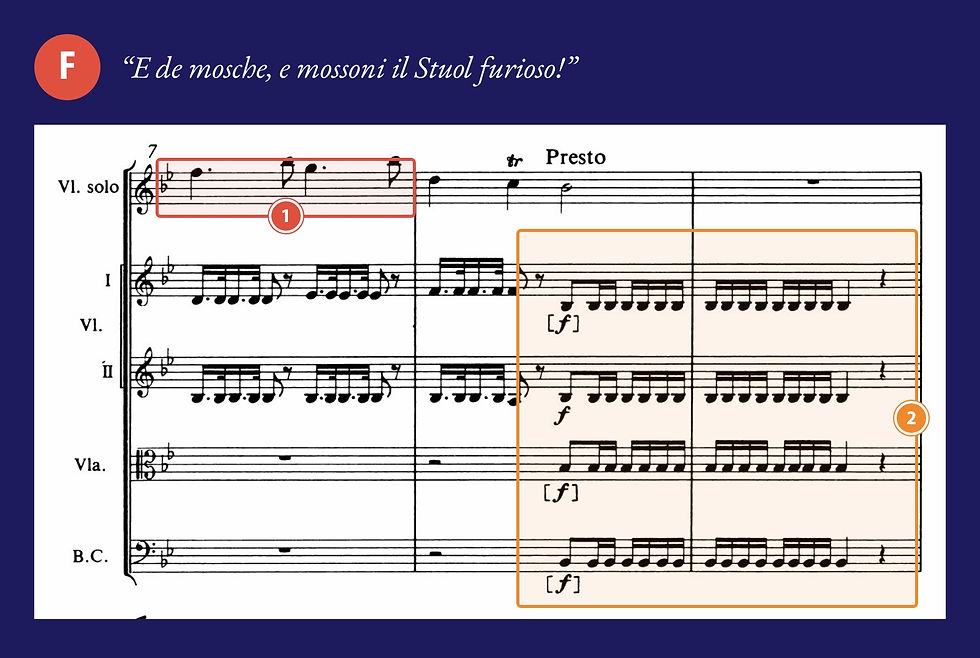
The flies: the solo violin holds long notes: the buzzing.
The thunder: the whole orchestra comes in forte, in fast repeated notes.
In the slow movement, weariness finds no rest. The violins keep up a long, insistent buzzing, the swarm of flies, and from time to time the whole orchestra bursts into thunder, closer each time.
III. Presto
Alas, his fears were all too true: The sky roars and flashes, mighty, And beheads the proud ears of grain.

The lightning: the violins play fast scales passed from one section to the other.
The hail: the viola plays tremolo notes without stopping.
The fear comes true. The storm breaks with full force in a furious tutti, full of scales and tremolo notes, and nothing is left standing in the fields.
Autumn: the harvest festival, the drunkard and the hunt
I. Allegro
The villagers celebrate, with dancing and song, The joy of a rich harvest; Fired up by Bacchus' liquor, many End their revels in sleep.

The festival: the orchestra plays the harvest dance theme.
The drunkard: the solo violin stumbles through scales and arpeggios that lose their balance (L’Ubriaco).
Autumn opens with a festive dance theme: the peasants celebrate the harvest. The wine flows, and the solo violin becomes the village drunkard, stumbling through scales and arpeggios that lose their balance and start again. Little by little the melody slows down, the party ends and the drunkard falls asleep.
II. Adagio molto
The mild air, a pleasure to all, Makes everyone stop their dancing and singing, And the season invites so many To give themselves to the sweetest sleep.

Sleep: the strings play with mutes, a muffled, distant sound (Ubriachi dormienti).
The haze of the wine: the harpsichord unrolls arpeggiated chords full of dissonances (Il cembalo arpeggio).
The whole slow movement is everyone's sleep. The strings play with mutes, a muffled, distant sound, and the harpsichord unrolls arpeggiated chords in a harmony full of dissonances, like a heavy sleep after too much wine.
III. Allegro
At first light the hunters Set out with horns, guns and dogs. The quarry flees, and they follow its trail; Terrified and worn out by the great noise Of dogs and guns, wounded, it tries to flee, And, exhausted, dies cornered.

The hunting horns: the strings imitate the horn calls (La caccia).
Early in the morning the hunters set out, and the strings imitate the calls of the hunting horns. The quarry flees: the solo violin runs, while the orchestra imitates the gunshots and the barking of the dogs. In the end the violin is hit, weakens and dies in a last phrase of pain.
Winter: chattering teeth, rain outside and cracking ice
I. Allegro non molto
To shiver, frozen, in the icy snow, In the harsh blast of a dreadful wind; To run, stamping one's feet every moment, And to feel one's teeth chatter in the bitter frost.

The shivering: the solo violin plays trills.
The cold: the dissonances and the staccato create a cold, harsh texture.
Winter has the most detailed sonnet, and the music follows every step. The concerto begins with dissonances and trills that slowly pile up: the body shivering with cold. A dreadful wind blows in the fast scales of the solo violin. The orchestra turns percussive, like someone running and stamping their feet to keep warm, and the soloist's teeth chatter in fast repeated notes.
II. Largo
To spend quiet, contented days by the fire, While outside the rain soaks everyone.

The fire: the solo violin plays a warm, comforting melody.
The rain: the violins play pizzicato, like raindrops outside.
The scene moves indoors. The solo violin sings a warm melody, of someone sitting by the fire, while the other violins pluck the strings with their fingertips, in pizzicato: the raindrops falling outside.
III. Allegro
To walk on the ice, with slow steps, Carefully, for fear of falling; To turn suddenly, slip and fall to the ground, Then get up and run quickly Before the ice cracks and breaks; To feel, through the bolted doors, The north wind blowing, all the winds at war: This is winter, but such a winter as brings joy.

Steps on the ice: the solo violin moves forward carefully, in notes that slip.
The frozen ground: the bass holds a long, continuous note (arcate lunghe).
The last movement takes everyone out onto the ice. A sustained low note is the frozen ground, and above it the violins move forward, slippery and careful, with slow steps. Suddenly someone slips and falls, in a fast scale that tumbles down. They get up and run again, the violin sliding over the ice, until the orchestra, with abrupt gestures, makes the ice break. Then comes a slow, sweet passage: the wind slipping in through the cracks in the door. Finally all the winds go to war, in scales and tremolos from the whole orchestra. Vivaldi closes the cycle with the line that has the last word in The Four Seasons.
Listening Suggestions
The tracks that accompany each movement in this post come from the recording by Il Giardino Armonico, the Italian period-instrument ensemble directed by Giovanni Antonini, with violinist Enrico Onofri, released in 1994. Below is the complete album on video, by the same ensemble.
References
EVERETT, Paul. Vivaldi: The Four Seasons and Other Concertos, Op. 8. Cambridge: Cambridge University Press, 1996.
TALBOT, Michael. The Vivaldi Compendium. Woodbridge: Boydell Press, 2011.
VIVALDI, Antonio. Le quattro stagioni, Op. 8/1–4. Ed. Simon Launchbury. London: Ernst Eulenburg, 1982.
Sonnet translations: Théo Amon (Portuguese); English version adapted by Bach Society Brasil.


Comments