


Bach as a teacher in Leipzig: the method, the rehearsals, and the 55 boys of the Thomasschule.

Updated: Sep 8
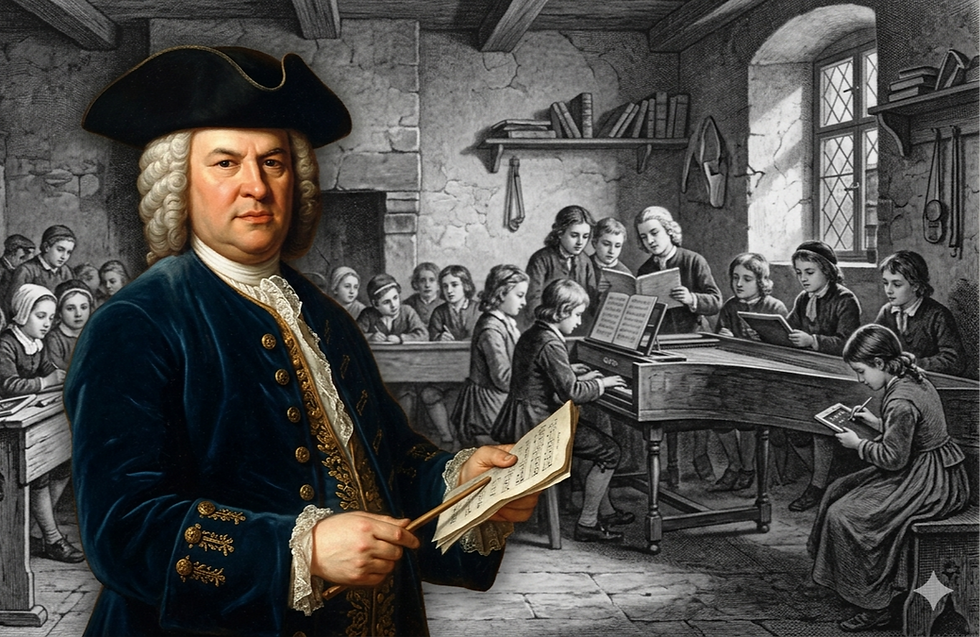
In June 1723, Johann Sebastian Bach spent his first month working as a teacher in charge of 55 boys at the Thomasschule.
He had signed a contract that obligated him not only to compose for Sundays, but to teach every day of the week. The Bach that Leipzig hired was, above all else, a critical and dedicated teacher.
The school under Bach's direction: four choirs, seven days a week.
The position Bach assumed on May 22, 1723, was primarily a school post. As Cantor of the Thomasschule , he was the third highest-ranking official at the Lutheran boarding school in Leipzig—below only the Rector and the Co-rector—and had direct responsibility for the musical education of about 55 boarding students, mostly orphans or children from poor families in the city. The boys were divided into four choirs, which performed every Sunday in the four main churches of Leipzig: Thomaskirche , Nikolaikirche , Neue Kirche , and Petrikirche .
Bach personally conducted only the first choir , alternating between Thomaskirche and Nikolaikirche according to the liturgical calendar. The other three choirs were led by prefects—advanced students whom he himself trained—and sang simpler repertoire. Christoph Wolff describes this arrangement as the “solar system” of Leipzig sacred music: Bach, at the center, fed the main choir with new work weekly; in the peripheral choirs, more experienced students kept the established motet and chorale in the repertoire. It was a pedagogical as much as a liturgical mechanism.
The boarding school routine was relentless, partly due to the methods of the time, partly due to Bach's high standards. Classes in the morning, rehearsal in the afternoon, Latin in between. On Saturdays, reading the cantata of the week; on Sundays, performance. Bach depended on these boys to perform, in full worship, the music he wrote at home from Thursday to Saturday. There was no plan B: if the soprano disappeared on Thursday, someone needed to be ready on Sunday morning.

The ruthless rehearsal director
As conductor of the weekly music program, Bach was—according to contemporary accounts—a formidable rehearsal leader. Johann Matthias Gesner , rector of the Thomasschule between 1730 and 1734 and a direct witness to the rehearsals, described Bach in a commentary published in 1738: conducting thirty or forty musicians simultaneously: “this single man capturing all the harmonies with his keen ear and emitting, with his voice alone, the tone of all the voices” ( The New Bach Reader , Doc. 328). Bach detected any out-of-tune voice immediately and, according to Forkel, intervened by showing the instrument what he wanted, rather than explaining with words. In a famous letter of 1775 to Forkel, Carl Philipp Emanuel summarizes his father: he was a musician who “taught by example, not by discourse.” When a student improvised a figured bass poorly, Bach would sit down to continuo , play the passage correctly once, get up, and continue the rehearsal.
The Cantata BWV 75 that Bach presented on May 30, 1723—the first under his direction in Leipzig—already contained the demands these boys would have to meet: 14 movements, high soprano voices, dense counterpoint, obbligato trumpet . It was not music for an average choir. John Eliot Gardiner argues that the entire first phase of the Cantatato in Leipzig should be read as a school by other means : each weekly cantata functioned as a practical lesson, in which Bach pushed his troupe of teenagers to the limit of what they could perform and, in the process, shaped them.
The house as a conservatory
Bach's pedagogy began long before Leipzig—and at home. On January 22, 1720 , in Köthen, he opened a music notebook inscribed Clavier-Büchlein vor Wilhelm Friedemann Bach and began the training of his eldest son, then 9 years old. The notebook contains, in the order in which Bach introduced them, the fingering chart , the Praeambula that would become the Inventions, and the first preludes of what would become the Well-Tempered Clavier. It is a living pedagogical document: it has erasures, corrections, and writings in the hands of Sebastian and the boy. Wolff describes this notebook as the "prototypical curriculum" that Bach would later apply to all his students.
In Leipzig, the family home continued to serve as a school. Anna Magdalena Bach received two Notenbüchlein —notebooks of small pieces copied and composed for her study—in 1722 and 1725. Carl Philipp Emanuel grew up copying scores from his father and, according to his own account, “never had another teacher”; he became, in the following generation, the most influential keyboardist in Northern Europe. Disciples such as Johann Ludwig Krebs , Johann Friedrich Agricola , Johann Christoph Altnickol (Bach's future son-in-law), Lorenz Christoph Mizler , and Johann Gottlieb Goldberg —the virtuoso who gives his name to the Variations BWV 988—passed through Bach's house in Leipzig. Christoph Wolff documents dozens of formal pupils throughout the 27-year period.

The keyboard method: from thumb to escape
Bach was a silent innovator of keyboard technique. The obituary written by Carl Philipp Emanuel Bach and Johann Friedrich Agricola in 1754—the primary source for everything we know of his teaching—records that he “brought to music a new fingering system ,” incorporating the thumb as the active finger in scales and arpeggios at a time when it was customary to use it only in special attacks. The innovation, commonplace today, was decisive: it made it possible to execute the chromatic passages and wide leaps that he demanded of his advanced students on the clavichord and harpsichord.
The pedagogy of the master Bach, as described by Johann Nikolaus Forkel in his 1802 biography—supported by testimonies from Wilhelm Friedemann and Carl Philipp Emanuel—is rigorous and progressive. The student began with months of fingering exercises , without playing any pieces; only then did they move on to the small preludes and the French Suites . Then came the material that Bach had explicitly composed as a school—the Two-Part Inventions and the Three-Part Symphonies (BWV 772–801) , organized in the 1723 autograph as Aufrichtige Anleitung (“honest instruction”) for the study of the “cantabile style” and polyphonic composition. The culmination of the course was the Well-Tempered Clavier , with its preludes and fugues in all 24 keys. Peter Williams observes that this sequence, in itself, defines the curriculum of the Baroque keyboardist as we know it today.
Bach's greatest demand, according to Forkel's description, was not speed or ornamentation: it was cantabile —making a percussion instrument sing . A student who played cleanly but without a melodic line failed. Carl Philipp Emanuel told Forkel that his father "preferred the clavichord to the harpsichord" for teaching, precisely because the clavichord responds to finger pressure and immediately reveals any stiffness in the touch. There was no way around it: each note betrayed the student.

The Eingabe of 1730: the limit of patience.
Seven years after signing the contract in Leipzig, Bach put his frustration with the academic aspect of the position on paper. The memorandum Kurtzer, jedoch höchstnöthiger Entwurff einer wohlbestallten Kirchen Music (“A brief but extremely necessary outline of well-regulated church music”), dated August 23, 1730, and addressed to the City Council, is a cold diagnosis. Bach lists and categorizes the 55 students of the Thomasschule and calls for more professional musicians and better pay for instrumentalists. Christoph Wolff describes the document as one of the most sober pieces ever written by Bach: no exaggeration, no exclamation—just numbers.
“For well-regulated ecclesiastical music, two types of people are needed: those who sing and those who play. (…) Of my current class of 17 usable students, 20 still in training and 17 unusable, only the first group can be employed in my principal choirs.” (Bach, Eingabe to the Council of Leipzig, August 23, 1730 — The New Bach Reader, Doc. 151.)
Two months later, on October 28, 1730 , Bach wrote a confessional letter to his childhood friend Georg Erdmann ( The New Bach Reader , Doc. 152). He confessed that he was considering leaving Leipzig: working conditions had worsened, extra payments (funerals, weddings) had decreased, and the “authority” of the position was constantly attacked. In the same paragraph in which he complained about mediocre students, he proudly reported that his family “is all born for music”—four of his children already knew how to form a vocal and instrumental ensemble.
The combination is key to Bach as a teacher. He complained about the raw material and, at the same time, transformed each weekly cantata into a lesson. He complained about the low level and, in his own backyard, trained the next generation of European keyboard masters. Peter Williams summarizes the paradox: the Eingabe shows a Bach exhausted by institutional teaching, but the catalog from the same period shows a Bach obsessed with creating didactic repertoire—Well-Tempered Clavier II, Clavierübung I to IV, Inventiones , sonatas for violin and harpsichord. The frustration with the Leipzig students produced, in parallel, the keyboardist curriculum that we still use today.
The Animation: Episode #19 – Arrival in Leipzig
In the video below, from the channel Bach: The Animated Series , episode #19 dramatizes the arrival of the Bach family in Leipzig and Sebastian's first contact with the responsibility of educating dozens of students in an environment that bore little resemblance to the comfort of the Köthen court.
About the series Bach: The Animated Series This episode is part of the independent series created and animated by artist Peter Fielding . Born in Flanders and based in Italy, Fielding explored the biography of Johann Sebastian Bach through a visual narrative that humanizes the composer's challenges.
The Bach Society Brazil presents the videos from the series as part of its outreach initiative. To understand the behind-the-scenes production and the author's creative process, read our exclusive interview with Peter Fielding.
Real or Fiction?
The animation gets the essentials right. The historical documentation, summarized by Christoph Wolff, confirms that arriving at the Thomasschule was, for Bach, the beginning of a school routine that he would never abandon: 55 boarding students, daily rehearsals, the obligation to teach Latin — a clause that Bach circumvented by negotiating with the Council to delegate the classes to a colleague from the Thomasschule itself, Carl Friedrich Pezold , in exchange for part of his salary.
Where the dramatization tends to romanticize is in the image of Bach as "grumpy" in front of the boys. The Eingabe of 1730 and the letter to Erdmann show an exhausted and critical Bach, yes—but also a methodical professional, who soberly documents the structural flaws of the system before complaining about any individual student. The real conflict was institutional, not personal. The teacher who complained was, in parallel, the teacher who trained.
Suggested Listening
The Well-Tempered Clavier , in Bach's method as described by Forkel, was the final step in the pedagogical journey—the student only reached this point after the Inventions , the Symphonies , and the Suites. Book II , completed in 1742, is a record of Bach as a mature teacher: 22 years after the first book, he revisits the 24 keys with an expanded didactic arsenal, integrating old and modern styles into a single collection.
The motets (BWV 225–230) were the bread and butter of the Thomasschule boys: music sung at funerals, requiems, and special services, generally a cappella with basso continuo. “Lobet den Herrn alle Heiden” (BWV 230), attributed to Bach by editorial tradition, concludes with a fugal Alleluia in a dance rhythm—the exact type of vocal and contrapuntal exercise that Bach demanded of his main choir.
Bibliographic References
BACH-ARCHIV LEIPZIG . Calendarium: A Timeline of the Life of Johann Sebastian Bach.
DAVID, Hans T.; MENDEL, Arthur; WOLFF, Christoph (Ed.) .The New Bach Reader: A Life of Johann Sebastian Bach in Letters and Documents . New York: WW Norton & Company, 1998.
GARDINER, John Eliot .Bach: Music in the Castle of Heaven . New York: Alfred A. Knopf, 2013.
WILLIAMS, Peter .JS Bach: A Life in Music . Cambridge: Cambridge University Press, 2007.
WOLFF, Christoph .Johann Sebastian Bach: The Learned Musician . New York: WW Norton & Company, 2000.
Audiovisual Production:
FIELDING, Peter . Bach: The Animated Series . 2024. Available at:https://www.youtube.com/@BachTheAnimatedSeries



Comments