


The myth of the Chaconne: Bach's mourning for the death of his wife Maria Barbara
Updated: Sep 8

In July 1720, Johann Sebastian Bach stepped out of a carriage in Köthen after nearly two months away in the service of Prince Leopold and was informed that his wife had died and was already buried.
No one had warned him about the illness; no one expected the funeral. At 35, Bach became a widower, father of four young children. This event gave rise to one of the greatest speculations about his work, involving the famous Chaconne for violin.
Maria Barbara: the cousin who became a wife
Maria Barbara Bach was born on October 20, 1684, in Gehren, Thuringia, the daughter of Johann Michael Bach —organist, composer of motets, and instrument maker—and Catharina Wedemann. She was a first cousin of Johann Sebastian: her father, Johann Michael, was the brother of Johann Ambrosius, the composer's father.
The Bachian genealogy, which Sebastian would organize decades later in Ursprung der musicalisch-Bachischen Familie , found in Maria Barbara yet another link in this network of hereditary musicians. As Christoph Wolff observes, marrying a Bach was a decision within the tradition: to prolong the professional lineage that had been sustaining the family since the 16th century.
The two met in Arnstadt , where Sebastian had taken up the post of organist at the Bonifaciuskirche in 1703. They married on October 17, 1707, in Dornheim , shortly after Sebastian had taken up his post in Mühlhausen. In thirteen years of marriage, they had seven children. Four survived. The twins Maria Sophia and Johann Christoph lived for only a few weeks in 1713, and little Leopold Augustus—the youngest son, named after the prince—died in 1719 at less than a year old. By July 1720, Maria Barbara had buried two children in seven years.
The family had moved to Köthen at the end of 1717, when Sebastian took up the post of Kapellmeister at the small Calvinist court of Prince Leopold of Anhalt-Köthen. It was the most stable period of Bach's adult life: a high salary, a refined musical environment, and the absence of the liturgical demands that would later consume him in Leipzig. Maria Barbara managed the household of a high-ranking court official who treated her husband as an equal.
The trip to Carlsbad: the Kapellmeister in service
In May 1720 , Prince Leopold departed for Carlsbad —the famous Bohemian spa town, now Karlovy Vary in the Czech Republic—for a period of bathing. It was common practice among the German high nobility to spend weeks in spa towns with a full retinue, including a doctor, servants, and musicians. Bach accompanied the prince as Kapellmeister, bringing with him part of the court's Kapelle to entertain his patron during his stay. The group carried their own instruments; harpsichords were hired locally when needed.
The entourage was away from Köthen for approximately two months. For Maria Barbara, it was her husband's second long absence in service to the same prince; in 1718, she had already managed the household without Sebastian for the same reason. No document suggests that he fell ill before leaving. Correspondence from the time does not mention any urgent message sent to Carlsbad requesting the Kapellmeister's return—which, given the speed of communications at the time and the distance (approximately 250 km between Carlsbad and Köthen), would likely have arrived too late.

The burial that took place without Bach
The Bach-Archiv Leipzig preserves the parish register: Maria Barbara Bach was buried on July 7, 1720, in the Jakobskirche of Köthen —the Lutheran church that, in a principality with a reformed government, served most of the population. The exact date of death is not documented; the Lutheran parish registers of the time recorded the burial, not the death. Wolff (p. 196) points to the probable interval between June 30 and July 5. The cause remains unknown—a historiographical convention worth repeating, because the literature on Bach is full of retrospective diagnoses without documentary basis.
The death certificate is dry and administrative. The entry for July 7th records only: “The wife of Lord Johann Sebastian Bach, Capellmeister to His Highness the Prince, was buried,” with the note that the full choir of the Latin school sang at the funeral—instead of the usual partial choir—and that the school reduced the customary rental fee. (Wolff, pp. 198–199.) Small gestures of respect for a musician from a recognized family.
It wasn't Sebastian who signed off on the arrangements. It was most likely his sister-in-law Friedelena , Maria Barbara's older sister who had been living with the family in Köthen for over a decade, or perhaps Catharina Dorothea , the eldest daughter—twelve years old, an age that Lutheran tradition at the time considered sufficient to handle household duties. The four surviving children—Catharina, Wilhelm Friedemann (10 years old), Carl Philipp Emanuel (6) and Johann Gottfried Bernhard (5)—remained in the care of the household while their father spent the last days of his stay in Carlsbad.

Speculations about the Chaconne and Bach's mourning
In 1720, the same year Maria Barbara died, Bach signed the handwritten autograph of the Sei Solo a Violino senza Basso accompagnato ( BWV 1001–1006 ), the set of three Sonatas and three Partitas for solo violin that is one of the pinnacle works of the Baroque period. Partita No. 2 in D minor culminates in a 257- measure Chaconne over a four-measure bass—a piece of such formal ambition that, since Brahms, it has received transcriptions for piano, cello, orchestra, and harpsichord, including the version for solo harpsichord by Fernando Cordella recorded by the Bach Society Brazil.
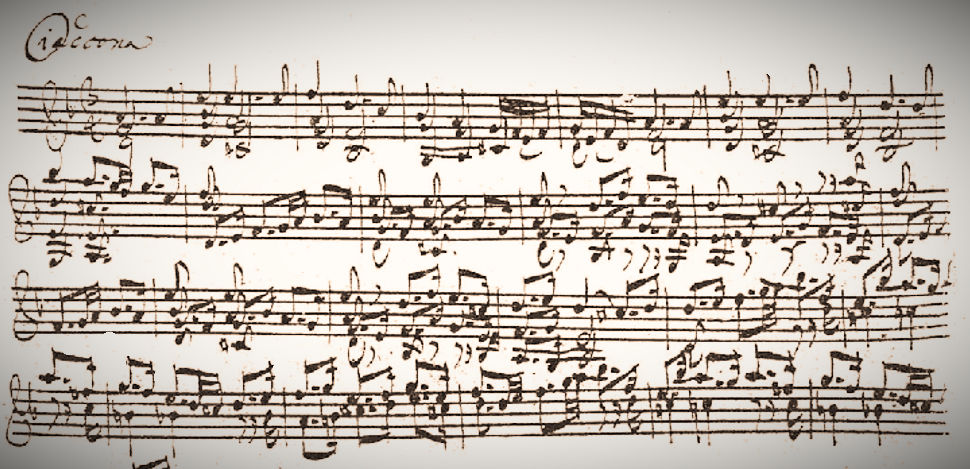
The chronological coincidence between the 1720 autograph and the wife's death fueled one of the most popular interpretative hypotheses of recent decades: German musicologist Helga Thoene argued, in studies published since 2001, that the Chaconne is a musical tombeau for Maria Barbara, with encrypted quotations from Lutheran chorales about death and resurrection. This thesis had a great public impact—especially after Christoph Poppen's recording superimposed on the melodies of the chorales sung by the Hilliard Ensemble—but it did not achieve musicological consensus. Christoph Wolff and Peter Williams treat it with reservation: the argument depends on numerical chains and thematic juxtapositions that, according to the critics, apply to almost any dense work by Bach. The autograph is dated 1720, but the work may have been composed over several years; and the tradition of the Baroque chaconne included both laments and triumphal dances.
It's worth noting for what it reveals about the reader themselves: the impulse to give an invisible loss a fitting sonic monument. Bach left us nothing explicit about Maria Barbara in his work. The Chaconne may or may not be her epitaph—but it is certainly the work from this period that most invites mourning in those who listen to it.
The Bach that returned: Forkel's account.
Almost a century later, Johann Nikolaus Forkel —biographer and first major researcher of Bach's work—collected from Wilhelm Friedemann and Carl Philipp Emanuel the most widely circulated version of the return. The account is stark and devastating:
“After thirteen years of an extremely happy marriage, he had the painful experience, upon returning from a trip, of not finding his wife alive. When he left, she was in good health; the news of her death only reached him upon returning home.” (Forkel, Über Johann Sebastian Bachs Leben, 1802 — The New Bach Reader, Doc. 306.)
The document does not reveal details about the composer's emotional state; what we know comes from indirect inference. Sebastian did not interrupt his professional life: in the following weeks, he resumed his obligations at the Kapelle, received new students, and in November 1720 , traveled to Hamburg for an audition at the Jacobskirche before the nearly centenarian Johann Adam Reincken . Peter Williams, in J.S. Bach: A Life in Music , observes that this period in Köthen—between July 1720 and his marriage to Anna Magdalena Wilcke on December 3, 1721—is the most opaque of Bach's biography. There are almost no letters, and the few official references deal only with administrative matters.
Seventeen months after Maria Barbara's death, Bach married Anna Magdalena Wilcke , a soprano at the Köthen court, twenty years his junior. This second marriage, documented in parish records, would give Bach thirteen more children and last until his death in 1750. Wolff resists psychological interpretations: for a man of almost forty with four young children, remarrying was a practical necessity, not a betrayal of grief. Maria Barbara had annual memorial masses held at the Lutheran court in Köthen, at least while Bach lived there; her name disappears from the sources after his move to Leipzig in 1723.
The Animation: Episode #15 – Grief and Guilt
About the series Bach: The Animated Series
The series is an independent narrative animation project by director Peter Fielding , born in Flanders and based in Italy, who has been reconstructing key moments in Johann Sebastian Bach's biography in short episodes. The Bach Society Brazil presents the videos on its blog as part of its initiative to promote Baroque music, offering younger generations an entry point into the Bachian universe. To learn more about Fielding's work and the behind-the-scenes of the project, read our exclusive interview with Peter Fielding.
Real or Fiction?
The animation gets the essentials right. The primary documentation—Forkel's account supported by Wilhelm Friedemann and Carl Philipp Emanuel, and the parish register preserved by the Bach-Archiv—confirms three central points: the trip with Leopold to Carlsbad in 1720, Bach's absence during Maria Barbara's illness and funeral, and the shock of his return. Also correct are the detail of the death of his son Leopold Augustus in 1719 (which the episode presents as an additional emotional weight) and Bach's position as Kapellmeister obliged to serve the prince on official business.
The dramatization of guilt , however, is an interpretive reading, not a document. Forkel describes the pain of returning; no contemporary testimony explicitly attributes guilt for the absence to Bach. The very institutional structure of the time makes the accusation anachronistic: a Kapellmeister of the court did not decide whether or not to accompany the prince to Carlsbad—it was part of the contract. Bach learned of the illness, if he knew at all, too late to return in time. The romanticized reading of the composer tortured by regret is a 19th-century construct, revived by the emotional format of the episode.
Another caveat: the animation focuses the tragedy on the wife's grief, but obscures the institutional continuity that followed. Bach did not stop. In November 1720 he traveled to Hamburg for the audition at the Jacobskirche; in December 1721 he married Anna Magdalena. The functional life of a court Kapellmeister with four children did not allow for paralysis. The grief that the primary source records is private, silent, and managed in parallel with his work—a Baroque grief, not a Romantic one.
Suggested Listening
The Chaconne from Partita No. 2 survives almost all transcriptions—Brahms transcribed it for piano only for the left hand, and Busoni expanded it into a monumental version for piano two-hands. Fernando Cordella takes up this path of interpretations in his own right: he transcribes the piece for solo harpsichord in an idiomatic solution inspired by Brahms' version, but which returns the work to the keyboard instrument closest to Bach's time. The effect is peculiar—where the Baroque violin sustains the melodic line in a single bow, the harpsichord exposes the underlying polyphony: the listener perceives that the Chaconne is, beneath the melody, a column of harmonic variations that fit on the keyboard as if they had always been there. The Bach Transcriptions program was the inaugural concert of the Bach Brasil series in 2020, recorded on period instruments .
The Chaconne is not alone in Partita No. 2: it is the fifth movement of a cycle of five that opens with this grave Allemande , passes through Corrente, Sarabande and Gigue, and culminates in the monumental Chaconne. Listening to the Allemande before the Chaconne is to enter the same affective tone of D minor — austere, dense, contemplative — on a more intimate scale: the opening prepares the emotional ground that the Chaconne will elevate to a monument. Márcio Cecconello presents the piece on Baroque violin — gut string, lighter bow, articulation that breathes the original phrasing — in the program The Violin — Bach's Instruments , from the Bach Society Brazil, dedicated to exploring the instrument that Bach had in mind when writing the Six Solos .
Bibliographic References
BACH-ARCHIV LEIPZIG . Calendarium: A Timeline of the Life of Johann Sebastian Bach.
DAVID, Hans T.; MENDEL, Arthur; WOLFF, Christoph (Ed.) . The New Bach Reader: A Life of Johann Sebastian Bach in Letters and Documents . New York: WW Norton & Company, 1998.
FORKEL, Johann Nikolaus . Über Johann Sebastian Bachs Leben, Kunst und Kunstwerke . Leipzig: Hoffmeister & Kühnel, 1802.
GARDINER, John Eliot . Bach: Music in the Castle of Heaven . New York: Alfred A. Knopf, 2013.
WILLIAMS, Peter . JS Bach: A Life in Music . Cambridge: Cambridge University Press, 2007.
WOLFF, Christoph . Johann Sebastian Bach: The Learned Musician . New York: WW Norton & Company, 2000. (Chap. 8, pp. 195–199.)
THOENE, Helga . Johann Sebastian Bach — Ciaccona: Tanz oder Tombeau? . Oschersleben: Ziethen, 2001.
Audiovisual Production: FIELDING, Peter . Bach: The Animated Series . 2024. Available at: https://www.youtube.com/@BachTheAnimatedSeries


Comments